


Fueling the Fast Lane
Buckle up, young learners!
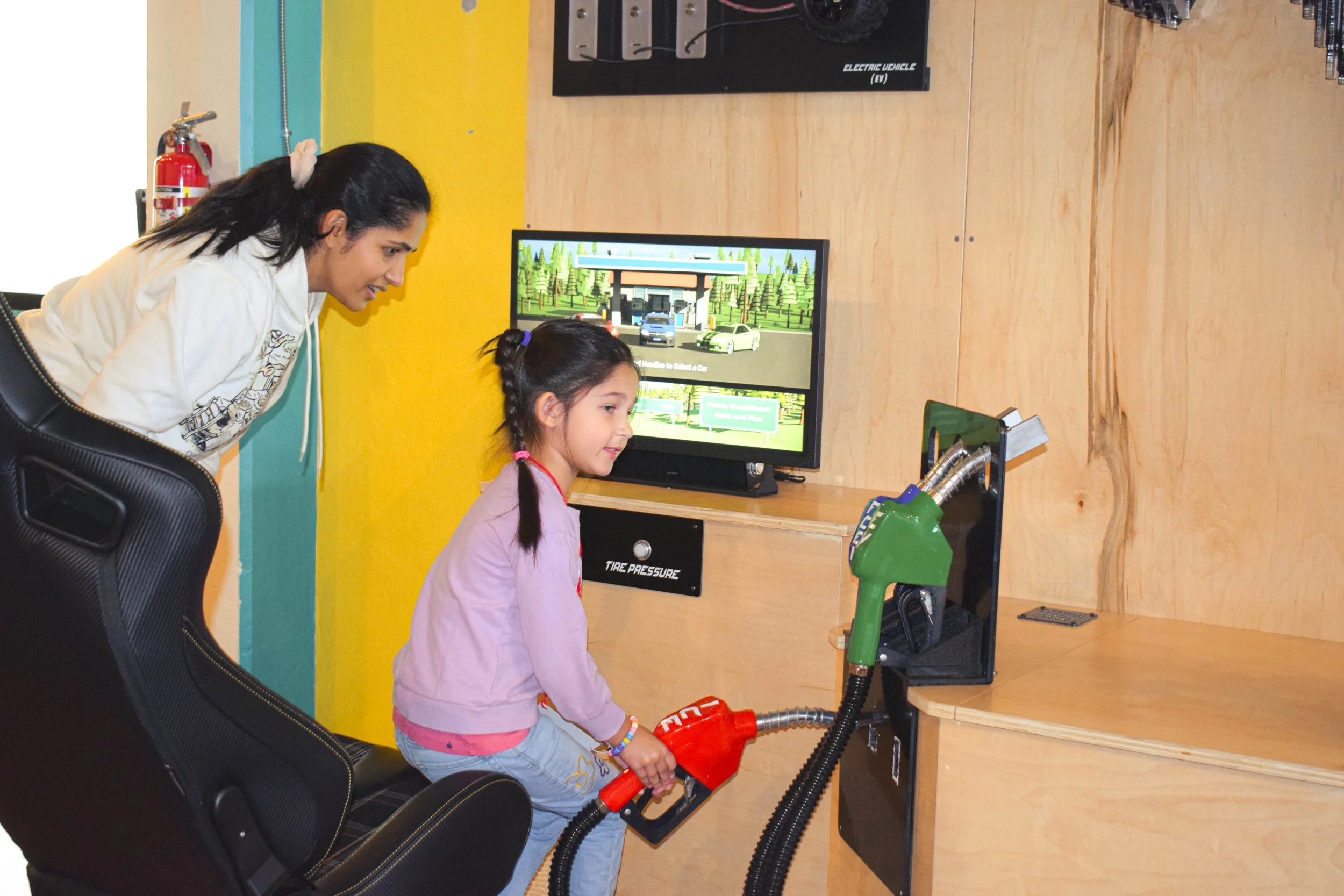
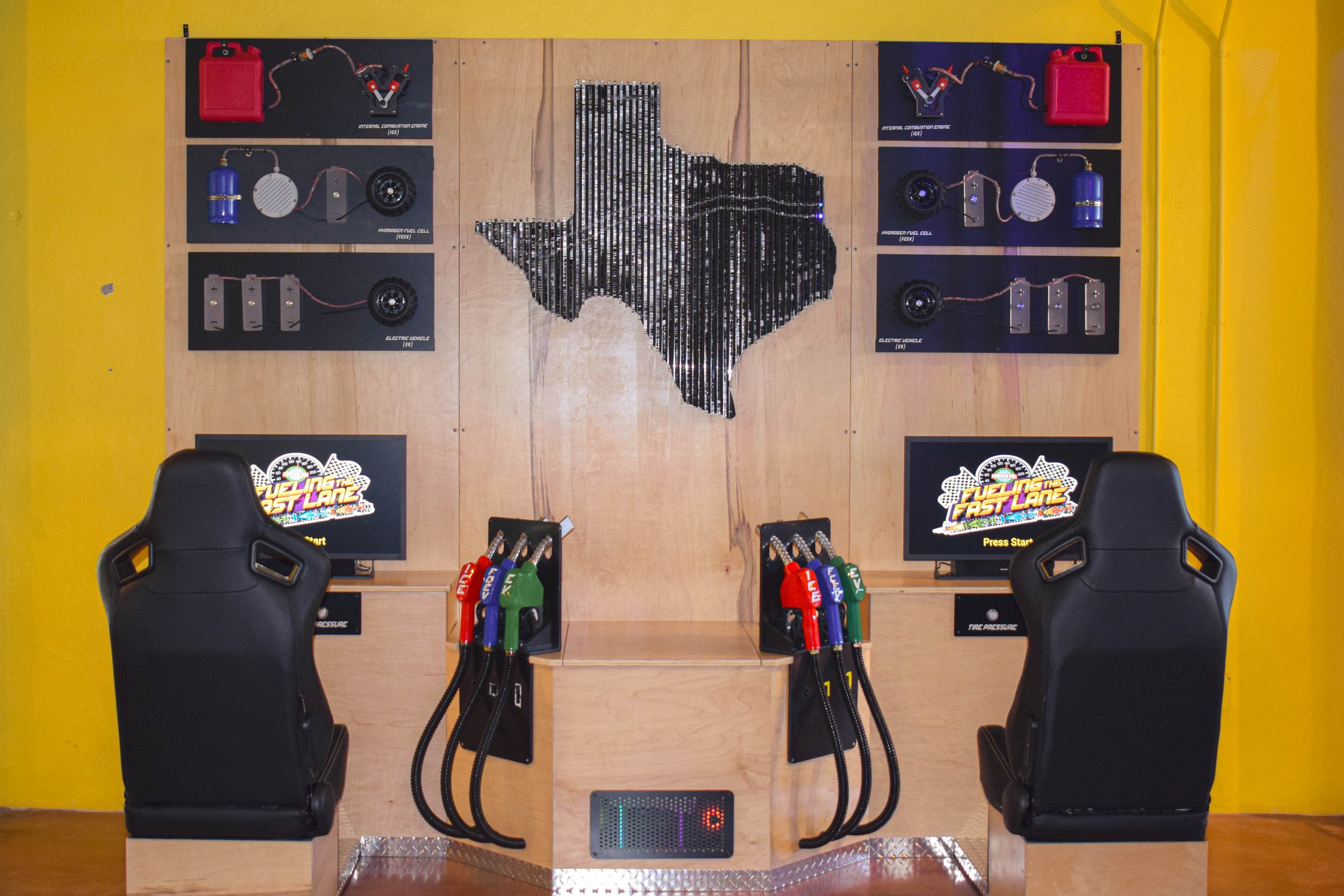
Fueling the Fast Lane challenges players to race across a simulated Texas landscape, comparing the carbon footprints of Internal Combustion Engine (ICE) vehicles, Electric Vehicles (EVs), and Hydrogen Fuel Cell Vehicles (HFEV). Players must navigate various environmental factors such as weather and terrain to determine which vehicle type can achieve the smallest carbon footprint while completing the journey.
Careers
Fuel Cell Engineer, Automotive Engineer, Electric Vehicle Technician
How to
Find a partner to race against and take a seat.
Press the Start button.
Follow the prompts on the screen to get moving!
To learn about each vehicle engine and select a car, choose a nozzle and place it in the slot below it that matches its shape.
Check your tire pressure at every stop.
Race across Texas in the most efficient way!
Challenge
Use a combination of vehicles to drive across Texas with the least amount of environmental impact.
Select a different vehicle for each section of the drive. What are your results?
Fueling the Fast Lane
¡Abróchate el cinturón, joven explorador!
Fueling the Fast Lane reta a los jugadores a competir por un paisaje simulado de Texas, comparando las huellas de carbono de tres tipos de vehículos: los de motor de combustión interna (ICE), los eléctricos (EV) y los de celda de combustible de hidrógeno (HFEV). Los jugadores deben explorar diversos factores ambientales, como el clima y el terreno, para determinar qué tipo de vehículo logra la menor huella de carbono al completar el recorrido.
Profesión
Ingeniero/a de celdas de combustible, ingeniero/a automotriz, técnico/a en vehículos eléctricos
¿Cómo hacerlo...?
Encuentra un compañero para competir y toma asiento.
Presiona el botón de Inicio.
Sigue las instrucciones en el juego para comenzar.
Para conocer el motor de cada vehículo y seleccionar un coche, elige una boquilla y colócala en la ranura de abajo que coincida con su forma.
Revisa la presión de tus llantas en cada parada.
¡Corre por Texas de la manera más eficiente posible!
Desafío
Usa una combinación de vehículos para conducir por Texas con el menor impacto ambiental.
Selecciona un vehículo diferente para cada sección del recorrido: ¿cuáles son tus resultados?
MORE EXHIBITS

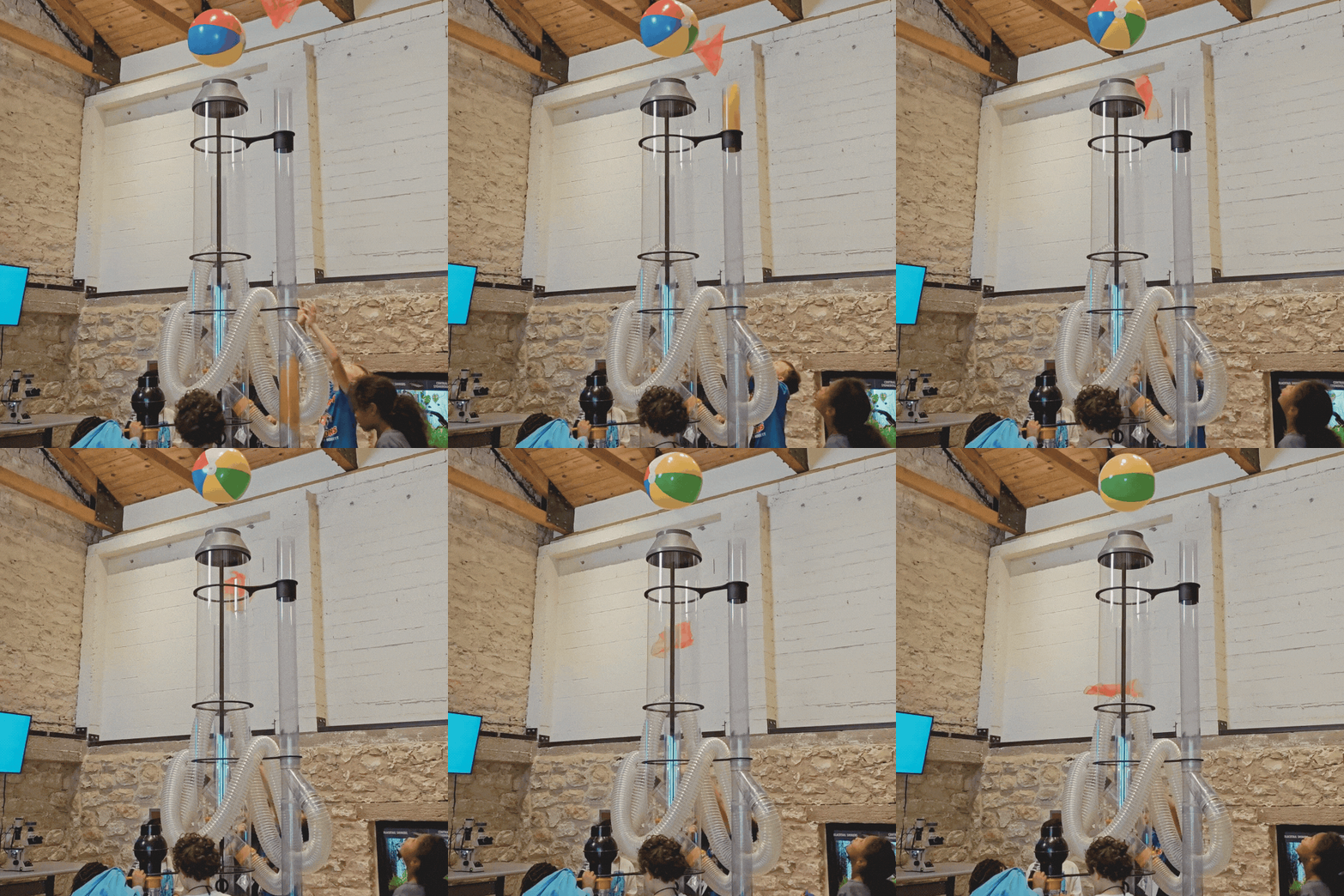
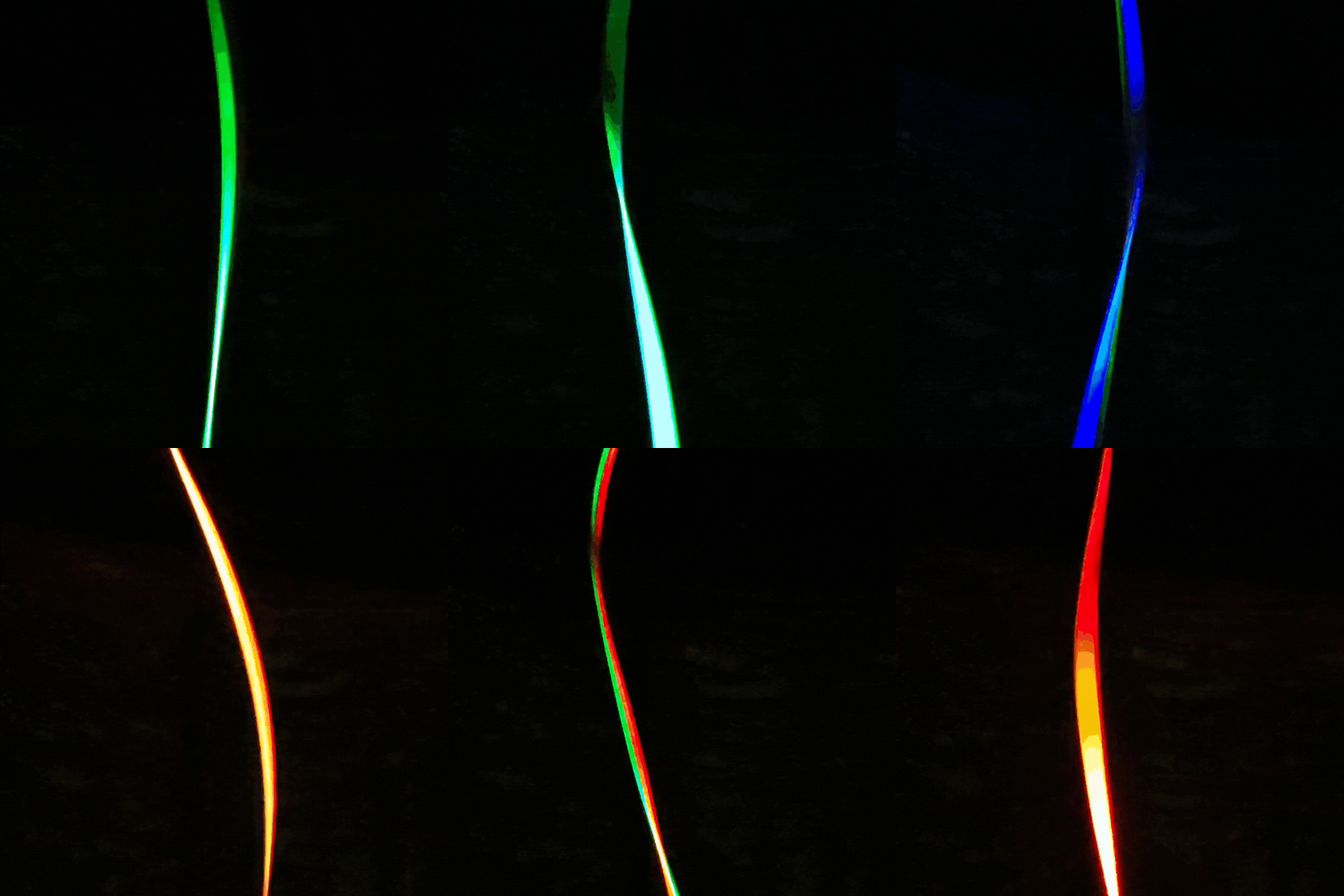
A white rope is suspended from a mounting point at the top of the Science Mill Silo. The bottom of this rope is attached to a motor mounted to the oor of the Silo. The motor churns the rope, sending waves of motion up and down its length. The undulating rope is illuminated by LED light. Looked at directly, this LED light appears white. However, the motion of the rope reveals that this white light is created by mixing various different colors of light together. Children engage the installation through a control interface made of touch-free optical sensors. Each sensor represents a different wavelength of visible light. These sensors control the LED color input being shone through the sculpture, resulting in different Additive Color combinations. A display near the control interface reveals the numerical values of the color wavelenght being displayed.


Try to spot the shy crabs that thrive in this mini ecosystem, alongside tropical fish and plants.
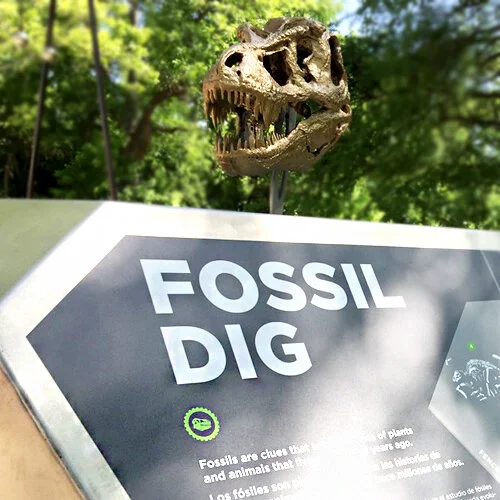
Fossils are clues that tell the stories of plants
and animals that lived millions of years ago.
Paleontology is the study of fossils and
seeks to map out how life evolved over
geologic time. Using clues from biology,
biochemistry, geology, mathematics and
engineering, paleontologists construct ideas
of how animals looked, behaved, interacted
and died.
Step into the Fossil Dig, grab some
excavating tools and use the skills of a
paleontologists to unearth the unique stories
of these amazing creatures! How many
fossils can you find in the Fossil Dig?

Step inside the silo to see your phone’s invisible radio waves become a dazzling light show.


The Colossal Robotic Hand is quite a sight: a 30-foot-tall, stainless steel robotic hand constructed from more than 500 individual, custom designed, stainless steel triangles. It is impressive in a stationary position, but with a remote joystick mimicking the robot hand, visitors can easily operate the Hand, making each of its giant fingers move, much like their own. This exhibit, in our Science & Art Park, is a powerful, interactive icon of creativity, engineering, and design.

What looks like space broccoli and can go on forever? It’s art that’s actually a math equation!

Soak up soundwaves and reveal a colorful surprise inside this exhibit by artist McKay Otto.

Step up to the control table and accept the challenge to manage the supply of electricity across homes and businesses in a virtual town. This interactive game will keep you on the move with quick thinking while teaching you the pros and cons of energy resources such as coal, natural gas, wind, nuclear, and solar power. Slide the levers and rotate the dials as you experience firsthand how our power grids, along with a variety of energy inputs, are used to supply electricity across the nation.
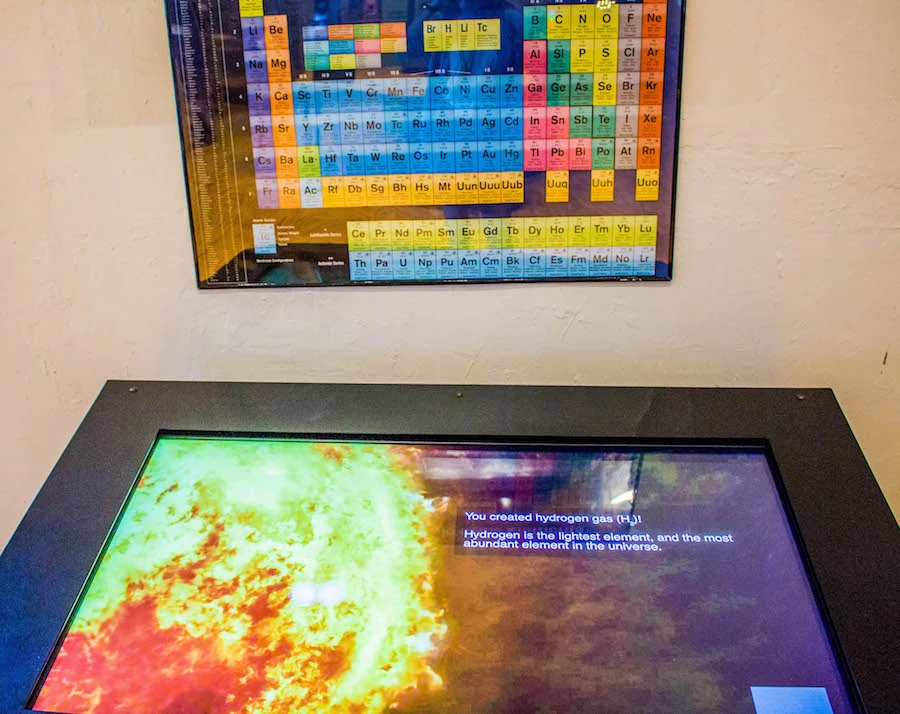
Play and experiment with tiny building blocks of life by mixing atomic combinations of carbon, hydrogen, nitrogen, oxygen, phosphorous, fluorine and chlorine. Enjoy the surprises as you create a variety of molecules found in nature and see their animations unfold on screen. Your chemistry concoction could do anything from allowing us to breathe to creating an explosion!

A visit to this exhibit allows you to interact with the human body like never before. The Virtual Human Body is a unique tool that allows people to explore different structures of the body. Using hand gestures and a 60-inch touchscreen display, viewers can swipe, zoom and slice the images to gain a deeper understanding of the functions and processes inside the human body. The visuals on display were collected using computerized tomography (also known as CT) scan technology that captures a series of image ‘slices’ to create the overall 3D image.

Do you love robots or have you wondered how they work? Sharpen your robotic skills at this exhibit by giving computerized commands to robotic animals and watch as the critters rattle, scratch and bellow their way into your heart. Each animal will move according to the instructions you give through blocks of text or computer commands, called a program.

Build a custom race car at the pit garage and race against others on a 25-foot track in this exciting design-build challenge. Learn the basics of simple machines and think like an engineer to build a speedy car. With this exhibit, you’ll build an awesome 3D puzzle that comes to life with speed when placed on the track!

Something’s gone wrong with your avatar! Can you find the DNA contaminate in it? Computers and DNA make the perfect team to help you with this mystery! This exhibit is designed to show you how scientists are using super-fast computers to unlock the genetic code of living organisms.

Bang! That’s the power of Chemistry. In this explosive example of water electrolysis, you’ll experience firsthand the transformation of electrical energy into chemical energy. Start the electrical current flowing in electrodes inside the clear flask of water. The electrical current splits the water molecules into two elements: hydrogen and oxygen. Once the hydrogen gas has been collected and loaded in the launch chamber, prepare to be amazed. The hydrogen gas combusts in a chemical explosion that launches a ping-pong ball up with a surprising bang!

Run your hands through real sand, forming mountains, rivers, lakes and dams in this interactive, augmented reality exhibit. Bring the concepts of geology, watersheds, erosion and topographic mapping to life while you create virtual topography in real time. Hold your hand above the sand to cast a shadow, causing virtual rain to fall from a virtual cloud. Carve a river in the sand and build a dam and watch as the water flows according to your design.

Come play with electricity at our AC/DC electricity exhibit. This station offers an introduction to designing electrical systems through creating and controlling electrical circuits. Choose from a series of "experiments," built around the basics of AC and DC electricity. You’ll be SHOCKED at how easy, cool, and safe the experiments are! (ba-dum-dum)

The word “pendulum” derives from the Latin pendulus, or ‘hanging down.’ However, the Wave Pendulum takes hanging down to a whole new level--12 new levels, to be exact. Twelve pendulums of increasing lengths are simultaneously released but have radically different outcomes as time progresses! The laws of physics artfully construct changing patterns with the 12 silver balls. Can you figure out why this happens?

The classic, old-fashioned windmill of rural backdrops gets an overhaul in this experimental exhibit allowing you to change the size and shape of turbine blades to generate maximum power. You will get to explore the amazing power of wind, an important resource for energy. Your challenge is to find the blade configuration that produces enough power to light up all three houses at once.

Ahoy, matey! Come set sail with us and experiment with wind and air pressure. Be the captain of your own boat by controlling the wind and sail positions to watch your vessel journey across the sea. Shiver me timbers, that’s one fast boat!

Challenge your friends to an old fashioned match in tug-of-war on this giant lever exhibit. As each side tugs the rope you’ll quickly learn that the two sides are not equal. Can you figure out why?

This mini architectural scale model of the Science Mill allows visitors to input the amount of rainwater surface collection area and simulated rainfall to see how many gallons can really be collected from the roof. The stunning detail of the model and representation of water conservation are complemented by the Science Mill’s 9600 gallon rainwater collection tank that can be seen right outside the window. The real rainwater has important uses such as outdoor irrigation and in the Zebrafish and Paludarium exhibits. This exhibit and our rainwater tank are sponsored by the Lower Colorado River Authority.

Remember Spirograph? Come try our new WonderGraph, a mesmerizing combination of physics, art and math!

Can you predict each ball’s path through a wacky maze with surprise twists, drops and loops?